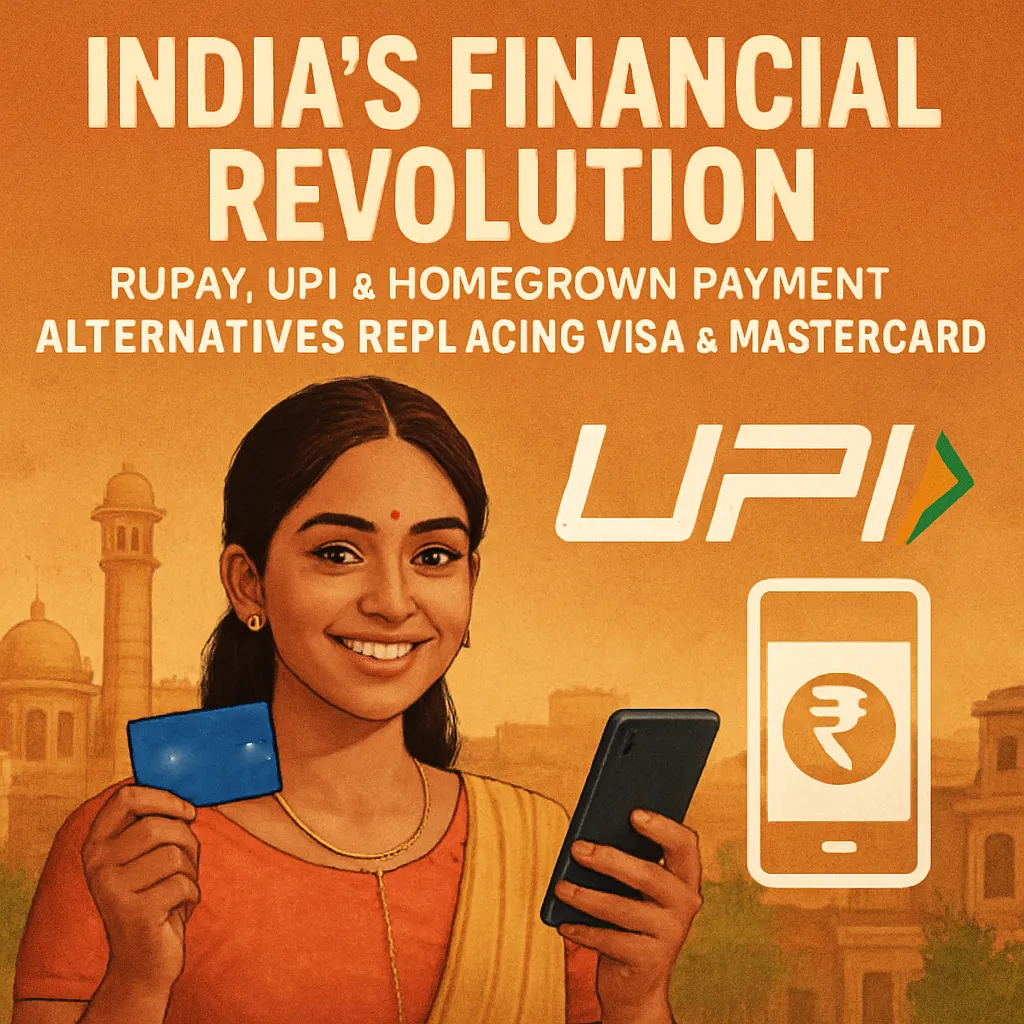
There is a financial revolution underway in India - quiet, deliberate, and of staggering scale.
For decades, two American companies have sat at the centre of virtually every cashless payment made anywhere in the world. Visa and Mastercard together facilitate transactions worth over $25.5 trillion globally - a network so dominant, so deeply embedded in banking infrastructure, merchant systems, and consumer behaviour, that most people never question whether an alternative could exist.
In India, a substantial portion of all cashless payments has historically flowed through these foreign networks. Every card swipe, every online transaction, every international payment - routed through American companies, processed on foreign infrastructure, governed by foreign rules, and carrying Indian consumers' sensitive financial data beyond India's jurisdiction.
But India did not accept this dependency as inevitable. Instead, India did what India does best when it sets its mind to something: it built its own.
RuPay - India's own card payment network. UPI - the Unified Payments Interface that has become the most remarkable payment infrastructure ever built anywhere in the world. NPCI - the National Payments Corporation of India, the institution that architected India's payment sovereignty and is now exporting it globally.
The numbers speak for themselves. UPI processed over ₹300 lakh crore (approximately ₹300 trillion) in transactions in the last year alone. India now processes more real-time digital payment transactions than the United States, the United Kingdom, and Germany combined. The country that was predominantly cash-dependent just a decade ago has built the world's most advanced digital payment ecosystem - entirely on homegrown infrastructure.
This is not just a fintech success story. It is a blueprint for what India can achieve across every dimension of its digital economy when it commits to building sovereign alternatives to foreign technology dominance.
Understanding the Problem: Why Foreign Payment Networks Are a Sovereignty Issue
To appreciate the significance of India's payment revolution, it helps to understand what was at stake - and what remains at stake wherever foreign payment networks still dominate.
The Data Sovereignty Problem
Every transaction processed through Visa or Mastercard generates data - not just financial data, but behavioural data. Where you shop. What you buy. How often. At what time. With what merchants. This data, aggregated across hundreds of millions of Indian consumers, creates an extraordinarily detailed picture of Indian consumer behaviour.
Under the current arrangement, this data is processed on foreign infrastructure, governed by foreign corporate policies, and potentially subject to foreign government access. India's citizens have limited visibility into how their transaction data is used, stored, or shared - and India's government has limited ability to regulate data that lives outside its jurisdiction.
Keeping transaction data within Indian borders, on Indian infrastructure, governed by Indian law, is not just a privacy preference. It is a fundamental aspect of financial sovereignty.
The Economic Dependency Problem
Visa and Mastercard charge interchange fees on every transaction processed through their networks. For Indian merchants, banks, and ultimately consumers, these fees represent a significant cost - and a recurring outflow of value from India's economy to foreign shareholders.
The precise scale of this outflow is difficult to quantify publicly, but across hundreds of billions of transactions annually, even small per-transaction fees accumulate to enormous sums. Every transaction routed through RuPay or UPI instead of Visa or Mastercard keeps that economic value within India.
The Geopolitical Vulnerability Problem
Payment infrastructure is strategic infrastructure. Countries that control their own payment networks have sovereignty over their financial systems. Countries that depend on foreign payment networks are vulnerable to decisions made by foreign corporations and foreign governments.
This is not hypothetical. In 2022, Visa and Mastercard suspended operations in Russia following geopolitical developments - effectively cutting off a significant portion of Russian consumers and businesses from cashless payment processing overnight. Whether one agrees with the reasons for that decision or not, it illustrates clearly that dependence on foreign payment infrastructure is a geopolitical vulnerability that can be activated at any time.
India - as a major global power with its own strategic interests and foreign policy positions - cannot afford this vulnerability. A payment system that can be switched off by a foreign corporation is not a sovereign payment system.
India's Answer: The NPCI Ecosystem
India's response to foreign payment network dependency was architectural, long-term, and comprehensive. The National Payments Corporation of India was established in 2008 as an umbrella institution for operating retail payment systems in India - a non-profit organisation jointly owned by Indian banks and mandated to build India's sovereign payment infrastructure.
What NPCI has built over the subsequent decade and a half is extraordinary by any global standard.
NPCI - The Institution Behind India's Payment Revolution
The National Payments Corporation of India is the architect and operator of India's entire homegrown payment ecosystem. It is not a commercial company with profit motives - it is a national infrastructure institution with a mandate to build payment systems that serve all Indians.
NPCI operates RuPay, UPI, IMPS, NACH, NETC, Bharat BillPay, and a growing range of other payment systems that together form the backbone of India's digital financial infrastructure. Its governance structure - jointly owned by India's major banks under RBI oversight - ensures that it operates in India's national interest rather than for the benefit of foreign shareholders.
The success of NPCI's approach demonstrates a model for digital sovereignty that goes beyond simply building an alternative product. It requires building sovereign infrastructure at the institutional level - infrastructure that is owned by India, governed in India's interest, and designed to serve India's specific needs.
RuPay - India's Own Card Payment Network
RuPay is India's domestic card payment network - a direct alternative to Visa and Mastercard for card-based transactions. Launched by NPCI in 2012, RuPay has grown to become one of the largest card networks in India, with hundreds of millions of RuPay cards issued across debit, credit, and prepaid categories.
Why RuPay Matters for Indian Consumers and Businesses
Every RuPay transaction is processed entirely within India's domestic payment infrastructure. Transaction data stays within Indian jurisdiction. Interchange fees stay within the Indian banking system. The economic value of every RuPay transaction circulates within India's economy rather than flowing to foreign shareholders.
For Indian banks, RuPay offers significantly lower processing costs than Visa or Mastercard - savings that can be passed on to consumers through lower fees and better rewards programmes designed for Indian spending patterns.
For the Indian government's financial inclusion agenda, RuPay has been particularly transformative. The Jan Dhan Yojana programme - which opened bank accounts for hundreds of millions of previously unbanked Indians - issued RuPay debit cards as the primary payment instrument. This decision meant that hundreds of millions of Indians who had never previously had access to formal payment systems entered the digital economy on Indian infrastructure from day one.
RuPay's Global Expansion
RuPay is not limited to India. NPCI International Payments Limited - NPCI's international subsidiary - is actively expanding RuPay's acceptance globally. RuPay cards are now accepted in dozens of countries, with expansion partnerships across Southeast Asia, the Middle East, and beyond.
This global expansion has a strategic dimension beyond commerce. As more countries adopt RuPay infrastructure - particularly under NPCI International's partnerships - India's payment network becomes part of global financial infrastructure, reducing India's dependence on Western-controlled payment networks for cross-border transactions.
UPI - The World's Most Advanced Payment System
If RuPay represents India's answer to foreign card networks, UPI represents something far more ambitious: a completely new paradigm for how digital payments work.
The Unified Payments Interface was launched in 2016 and has since become the most successful payment innovation in the world. Its core insight was simple but revolutionary: instead of building a payment system around cards and card numbers, build it around bank accounts and mobile phones - the two things that nearly every Indian either has or will soon have.
What Makes UPI Genuinely Revolutionary
UPI enables instant, real-time bank-to-bank transfers using just a mobile phone. No card required. No card number to share. No sensitive financial credentials transmitted to merchants. No intermediary between the payer's bank and the payee's bank. Just a Virtual Payment Address - effectively a financial username - and a UPI PIN.
The security architecture of UPI is fundamentally superior to card-based systems. When you pay with a Visa card online, you share your 16-digit card number, expiry date, and CVV with every merchant - credentials that can be stolen and used for fraud. When you pay with UPI, you share only your VPA - a non-sensitive identifier - and authenticate with a PIN that never leaves your device. Merchants never see your bank account details.
UPI is also free. The government's policy decision to maintain UPI as a zero-fee system for consumers and small merchants has been one of the most significant drivers of India's digital payment revolution. When there is no cost to using digital payments, the barrier to adoption disappears.
The Scale of UPI's Success
The numbers surrounding UPI's growth are almost difficult to comprehend.
UPI processed over ₹300 lakh crore - approximately ₹300 trillion - in transactions in the last year. This is not just large in Indian terms. It is the largest volume of real-time payment transactions processed by any payment system anywhere in the world.
India now processes more real-time digital transactions daily than the United States processes in a month. Countries with far more developed financial infrastructure and far higher GDP per capita process a fraction of the real-time payments that India processes - because no other country has built payment infrastructure that is simultaneously as accessible, as free, and as technically capable as UPI.
The growth trajectory is equally remarkable. UPI barely existed in 2016. By 2020, it was processing billions of transactions monthly. By 2026, it has become the default payment method for hundreds of millions of Indians across every income level, every age group, and every geography.
UPI's International Expansion
NPCI International is actively expanding UPI's reach beyond India. UPI payments are now accepted in several countries including Singapore, UAE, Bahrain, Nepal, Sri Lanka, France, and others - with more partnerships being added regularly.
For Indian travellers and the Indian diaspora, UPI acceptance internationally means being able to pay abroad using Indian bank accounts without foreign exchange fees and without depending on foreign card networks. For India's strategic interests, UPI's international expansion creates payment infrastructure corridors that operate outside Western-controlled financial systems.
BHIM - UPI for Every Indian
BHIM - Bharat Interface for Money - is NPCI's own UPI application, designed as a simple, accessible, government-backed interface for UPI payments. Named after Dr. B.R. Ambedkar, BHIM was designed specifically for accessibility - supporting multiple Indian languages, working on basic smartphones, and providing a straightforward interface that does not require technical sophistication to use.
BHIM's significance is primarily in its role as the universal, government-backed UPI access point - ensuring that even Indians who do not use private sector UPI apps like PhonePe or Google Pay have access to UPI through a trusted, sovereign application. It also provides a baseline of competition that prevents any private platform from monopolising UPI access.
NPCI International - Exporting India's Payment Revolution
NPCI International Payments Limited is the subsidiary established to take India's payment innovations to the world. Its mandate is to export RuPay and UPI to other countries - both as payment acceptance for Indian travellers and as infrastructure that other countries can adopt for their own domestic payment systems.
Several countries are actively exploring adopting UPI-like real-time payment systems based on NPCI's technology. This represents a remarkable shift in the global payment landscape - from a world where American companies (Visa, Mastercard, PayPal, Stripe) export payment infrastructure to developing countries, to a world where India exports payment infrastructure that other countries adopt.
NPCI International's work has strategic significance beyond commerce. As more countries adopt NPCI-derived infrastructure, India becomes a centre of global payment technology - a provider of financial infrastructure rather than simply a consumer of it.
The Broader Indian Payment Ecosystem
NPCI's infrastructure - RuPay, UPI, BHIM - provides the sovereign foundation on which India's broader payment ecosystem is built. On top of this foundation, a vibrant private sector has built the merchant-facing, developer-facing, and consumer-facing products that make India's payment revolution practically accessible.
-
Razorpay
India's most comprehensive payment gateway, processing billions of dollars in transactions annually for hundreds of thousands of Indian businesses. Built entirely on Indian infrastructure with deep UPI and RuPay integration, Razorpay gives Indian businesses a payment processing capability that is technically superior to foreign alternatives for Indian transactions.
-
CCAvenue
One of India's oldest and most established payment gateways, with over two decades of experience processing Indian transactions across 200+ payment methods. CCAvenue's depth of Indian payment method support - covering every bank, every wallet, every UPI variant - is something no foreign processor can match.
-
Easebuzz
A modern Indian payment platform built specifically for startups, educational institutions, and growing businesses, offering competitive pricing, simple integration, and strong Indian support.
-
PayU
A global payment company with deep Indian roots and operations, offering comprehensive Indian payment processing with strong UPI and RuPay integration.
-
Cashfree Payments
A growing Indian payment platform offering fast settlements, strong API capabilities, and comprehensive Indian payment method support.
-
BillDesk
One of India's pioneering online payment platforms, processing a significant share of India's bill payment and subscription payment volumes.
Together with NPCI's infrastructure, these companies form a payment ecosystem that is genuinely world-class - technically sophisticated, comprehensively covering Indian payment preferences, and entirely operated on Indian infrastructure.
Explore all 13 Indian Payment GatewaysIndia's Payment Revolution in Global Context
India's payment revolution has not gone unnoticed globally. The world is watching - and learning.
The World Bank, the Bank for International Settlements, and central banks across multiple countries have studied UPI as a model for domestic payment infrastructure. Several countries - including Singapore, which partnered with NPCI for PayNow-UPI interoperability - have directly integrated with India's payment infrastructure.
G20 discussions on improving cross-border payments have prominently featured UPI as a model worth studying and potentially replicating. India's presidency of the G20 in 2023 used the platform to showcase UPI as a global public good - payment infrastructure that other developing countries could adopt to build their own payment sovereignty.
The global recognition of UPI's success has an important implication: India is no longer just a market that global payment companies are trying to penetrate. India is a source of payment innovation that the world wants to learn from and adopt. This is a profound shift in India's position in the global financial technology landscape.
What You Can Do to Support India's Payment Revolution
The shift from foreign payment networks to Indian alternatives is well underway - but individual and business choices accelerate it.
For Individual Consumers
Request a RuPay debit or credit card from your bank. Most Indian banks offer RuPay as an option - and some offer better rewards on RuPay cards than on Visa or Mastercard cards for domestic transactions. Every RuPay transaction you make instead of a Visa or Mastercard transaction keeps value within India.
Use UPI for as many transactions as possible. For merchant payments, peer transfers, bill payments, and online purchases, UPI is technically superior to card-based alternatives - more secure, faster, and free.
For Businesses
Ensure your payment gateway prominently supports UPI and RuPay. For Indian businesses, accepting UPI should be the primary payment method offered - not an afterthought alongside foreign card networks. UPI's zero-fee structure for many transaction types directly reduces payment processing costs.
Choose Indian payment gateways - Razorpay, CCAvenue, Easebuzz, PayU, Cashfree - over foreign alternatives like Stripe and PayPal for processing Indian transactions. Indian gateways are better integrated with India's payment infrastructure, offer better success rates for Indian transactions, and keep payment processing within Indian jurisdiction.
For Advocacy
Support policies that strengthen India's payment sovereignty - including RBI's data localisation requirements, NPCI International's international expansion efforts, and government procurement policies that favour Indian payment infrastructure for public sector payments.
Conclusion
India's financial revolution is not a future aspiration. It is a present reality, measured in ₹300 trillion of UPI transactions, hundreds of millions of RuPay cards, and a payment ecosystem that the world looks to as a model.
The concerns that motivated this revolution - data sovereignty, financial independence, geopolitical vulnerability, and the need for payment infrastructure designed for Indian needs - have been addressed through the extraordinary work of NPCI, the Indian banking system, and a vibrant private sector fintech ecosystem.
Every Indian who uses UPI instead of a foreign card network, every merchant who accepts RuPay, every business that processes payments through an Indian gateway rather than a foreign one, is contributing to this revolution. They are keeping Indian financial data in India. They are keeping economic value in India. They are building the financial sovereignty that a nation of India's scale and ambition deserves.
The world built its payment infrastructure around Visa and Mastercard. India built something better. Now India is sharing that innovation with the world.
India's financial freedom is not taking shape. It has already arrived. 🇮🇳
Explore Indian payment alternatives and the complete Indian digital ecosystem at: