Artificial intelligence is the defining technology of this decade. But a critical question hangs over its development globally: whose intelligence is it, really?
The dominant AI systems of our time - ChatGPT, Gemini, Claude, Llama - were built primarily with Western data, Western language contexts, and use cases that reflect Western economic and social priorities. They are extraordinary engineering achievements. But they are not, in any meaningful sense, built for the 1.4 billion people of India, the 800 million people of sub-Saharan Africa, or the hundreds of millions of people across Southeast Asia, Central Asia, and Latin America whose languages, needs, and contexts are systematically underrepresented in the world's most powerful AI systems.
India's response to this challenge was on full display at the India AI Impact Summit 2026 in New Delhi - a gathering that set a transformative agenda for how artificial intelligence can and should be developed to serve not just the technologically privileged, but all of humanity.
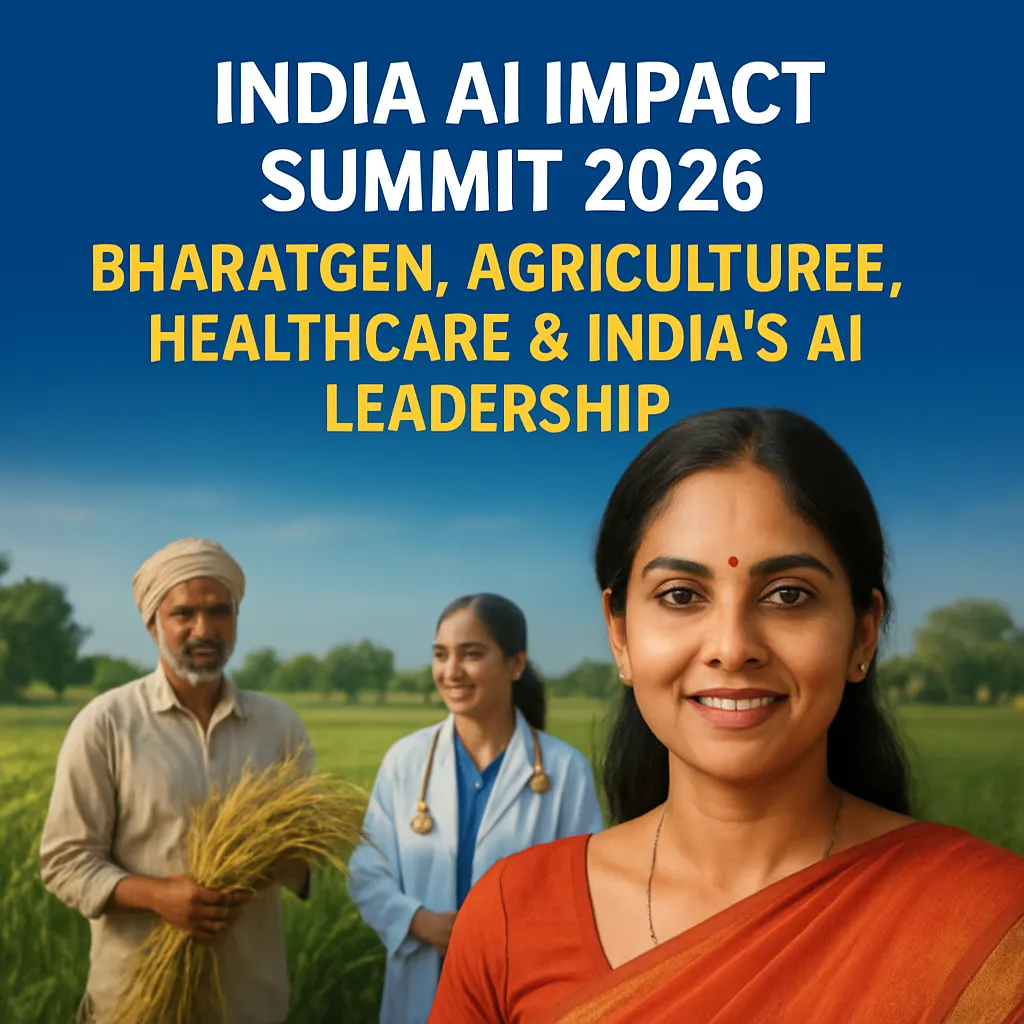
The summit's agenda covered four domains that collectively represent India's vision for AI as a force for genuine social good: language inclusivity through the BharatGen Param2 model supporting all 22 regional languages; agricultural empowerment through AI tools designed specifically for India's farming communities; healthcare transformation through predictive analytics and personalised treatment AI; and sustainable industry through AI-driven resource optimisation and environmental impact reduction.
Together, these four pillars represent something that no other country is currently doing at this scale or with this clarity of social purpose: building AI that is specifically designed to improve the lives of the people who need it most.
Why India AI Impact Summit 2026 Matters Beyond India
Before diving into the specifics, it is worth establishing why what happened in New Delhi matters for the global AI conversation.
India is not a peripheral player in global AI. It is the world's most populous country, home to one of the largest concentrations of AI engineering talent anywhere, and the site of one of the fastest-growing AI startup ecosystems on earth. India's choices about how it develops and deploys AI will shape the global AI landscape in ways that cannot be ignored.
More importantly, the problems that India is trying to solve with AI - how to deliver services in dozens of languages to populations with varying literacy levels, how to empower smallholder farmers with actionable data, how to extend quality healthcare to communities far from urban medical infrastructure, how to industrialise responsibly in a climate-constrained world - are not uniquely Indian problems.
They are the defining challenges of human development in the 21st century. And the AI solutions that India builds to address them will be applicable, adaptable, and valuable across the developing world.
When India leads on AI for social good, it is not just building for its own 1.4 billion people. It is building a template for how AI can serve humanity's most pressing needs - a template that Silicon Valley, focused primarily on maximising engagement and advertising revenue, has not been in a position to develop.
BharatGen Param2 - AI That Speaks Every Indian's Language
The most foundational announcement from the India AI Impact Summit 2026 was also, in many ways, the most important for India's long-term AI development: the BharatGen Param2 model, designed to support all 22 regional languages recognised under India's Constitution.
The Language Barrier - AI's Invisible Wall
India's linguistic diversity is extraordinary. The country has 22 officially recognised languages, hundreds of dialects, multiple scripts, and a population where hundreds of millions of people are more comfortable - or exclusively comfortable - in a language other than Hindi or English.
The dominant global AI models handle English superbly. They handle Hindi with reasonable competence. They handle Tamil, Telugu, Kannada, Bengali, Odia, Assamese, Punjabi, Gujarati, Marathi, Malayalam, and India's other major languages with varying degrees of inadequacy - producing outputs that native speakers often recognise as technically correct but culturally hollow, or that make errors that reveal a lack of genuine language training data.
For the hundreds of millions of Indians who interact with the world in these languages, this is not a minor inconvenience. It is a wall. A wall that separates them from the benefits of AI - the ability to access information, receive guidance, interact with services, and participate in the digital economy using AI-powered tools - that English-speaking and Hindi-speaking Indians increasingly take for granted.
What BharatGen Param2 Delivers
BharatGen Param2 is a multilingual AI model trained specifically on high-quality data across all 22 of India's constitutionally recognised languages. Its design addresses not just the vocabulary and grammar of each language but the cultural contexts, regional idioms, and communication patterns that make a language model genuinely useful rather than technically functional.
The implications span every sector. A farmer in rural Odisha can query an AI in Odia to get recommendations on crop disease management. A patient in Tamil Nadu can receive AI-assisted healthcare guidance in Tamil. A student in Assam can access AI-powered tutoring in Assamese. A small business owner in Gujarat can use AI-powered accounting tools in Gujarati.
These are not marginal use cases. They represent India's actual population - the hundreds of millions of people who have been underserved by every AI system built to date because their languages were treated as second-tier considerations rather than first-class design priorities.
The Broader BharatGen Initiative
BharatGen Param2 builds on India's broader BharatGen initiative - a government-supported programme to develop AI models grounded in Indian languages and contexts. The "Param" in the name references India's Param supercomputing infrastructure, reinforcing that this is not just a model but an ecosystem - AI capabilities built on Indian computational infrastructure, trained on Indian data, and deployed for Indian users.
This initiative positions India as a global leader in multilingual AI - not just for its own population but as a demonstration that large-scale, high-quality multilingual AI is achievable and that the global AI community should be investing in linguistic diversity as a core priority.
Explore all Indian AI AlternativesIndia's AI Ecosystem - The Companies Delivering the Summit's Vision
The ambitious agenda set at the India AI Impact Summit 2026 is not purely aspirational. It is grounded in an Indian AI ecosystem that is already building and deploying the capabilities the summit envisions.
-
Sarvam AI
whose Kaze AI smartglasses were unveiled at the very same summit - has built multilingual AI models including Sarvam Vision and Bulbul V3 that support Indian language interaction and have benchmarked above ChatGPT and Gemini on Indian-language tasks. Sarvam's work directly enables the language inclusivity agenda that BharatGen Param2 advances at the government level.
-
Gnani.ai
India's leading voice AI platform - supports over 20 Indian languages with voice interaction capabilities that are deployable by ASHA workers, farmers, and patients who may not be comfortable with text-based interfaces. Gnani.ai's technology is directly applicable to the agricultural and healthcare AI use cases highlighted at the summit.
-
Yellow.ai
processing billions of enterprise customer interactions in Indian languages - provides the conversational AI infrastructure that can deliver agricultural market intelligence, healthcare guidance, and industrial management support at the scale India needs.
-
Krutrim by Ola
India's first AI unicorn - is building the foundational large language model infrastructure that can power a generation of Indian AI applications across all the sectors highlighted at the summit.
-
Fractal
providing enterprise AI and analytics to leading organisations globally - brings the analytical AI depth that industrial optimisation, healthcare analytics, and agricultural intelligence require at enterprise scale.
India's AI Vision vs Global AI Development - A Crucial Difference
It is worth pausing to reflect on what distinguishes India's AI vision - as expressed at the India AI Impact Summit 2026 - from the dominant direction of global AI development.
The global AI industry is primarily driven by commercial incentives centred on productivity, engagement, and advertising. The largest AI investments are going into productivity tools for knowledge workers, content generation for marketing, and engagement optimisation for social platforms. These are valuable applications - but they primarily serve the technologically privileged, primarily in high-income countries.
India's AI vision, as expressed at the summit, starts from a different premise: that AI should be evaluated by its impact on those who need it most. Farmers who lack access to agronomic expertise. Patients in communities far from specialist medical care. Industrial workers and communities affected by environmental pollution. Citizens who have been excluded from the benefits of digital technology because it does not speak their language.
This is not a rejection of commercial AI development. India's private sector AI companies are commercially driven and globally competitive. But it is an insistence that the measure of AI's success must include its impact on social good - not just its impact on productivity metrics in high-income knowledge work.
This distinction matters because it is directional. The AI capabilities that India is investing in - multilingual models, agricultural intelligence, rural healthcare AI, environmental monitoring - will create value that is widely distributed across Indian society, not concentrated among the already privileged.
This is the AI agenda that India is putting on the table for the world. And it is an agenda that deserves attention, support, and - where appropriate - replication.
What India's AI Leadership Means for the Global South
India's emergence as an AI leader specifically in social good applications has implications that extend far beyond India's borders.
Countries across Africa, Southeast Asia, South Asia, and Latin America face development challenges that are structurally similar to India's: linguistic diversity, agricultural economies with smallholder farming at their core, healthcare systems straining under population scale, and industrialisation goals that must be balanced against environmental constraints.
The AI solutions that India develops for these challenges - multilingual models, agricultural AI for tropical farming contexts, rural healthcare AI, industrial sustainability tools - are directly applicable to these countries' needs in ways that AI solutions built for Western contexts are not.
India is not just solving its own problems. It is building a library of AI solutions for the developing world - solutions that, through NPCI International's payment infrastructure analogy, could be exported and adopted globally just as UPI's payment architecture is being studied and adopted by other countries.
This is what genuine AI leadership for humanity looks like. And India is pursuing it with increasing clarity and ambition.
Conclusion
The India AI Impact Summit 2026 in New Delhi was more than a technology conference. It was a statement of values - a declaration that India intends to use artificial intelligence as a tool for genuine human development, not just as a source of commercial productivity gains for the already privileged.
BharatGen Param2's support for all 22 Indian regional languages ensures that AI's benefits reach every Indian, regardless of which language they speak. Agricultural AI tools empower 140 million farmer households with data-driven insights that can transform rural livelihoods. Healthcare AI extends predictive and personalised medicine to communities far from urban medical infrastructure. Sustainable industry AI enables India's industrialisation to proceed with minimum environmental impact.
Together, these four pillars represent India's AI agenda for the world - an agenda that is simultaneously ambitious and pragmatic, visionary and grounded in immediate human need.
India is not just participating in the global AI race. It is defining a lane of that race that matters most for humanity's future - AI that serves everyone, in every language, in every community, for every need.
Explore India's complete
AI ecosystem
at
India's commitment to AI for social good is
not a declaration of intent.
In 2026,
it is a programme of action.