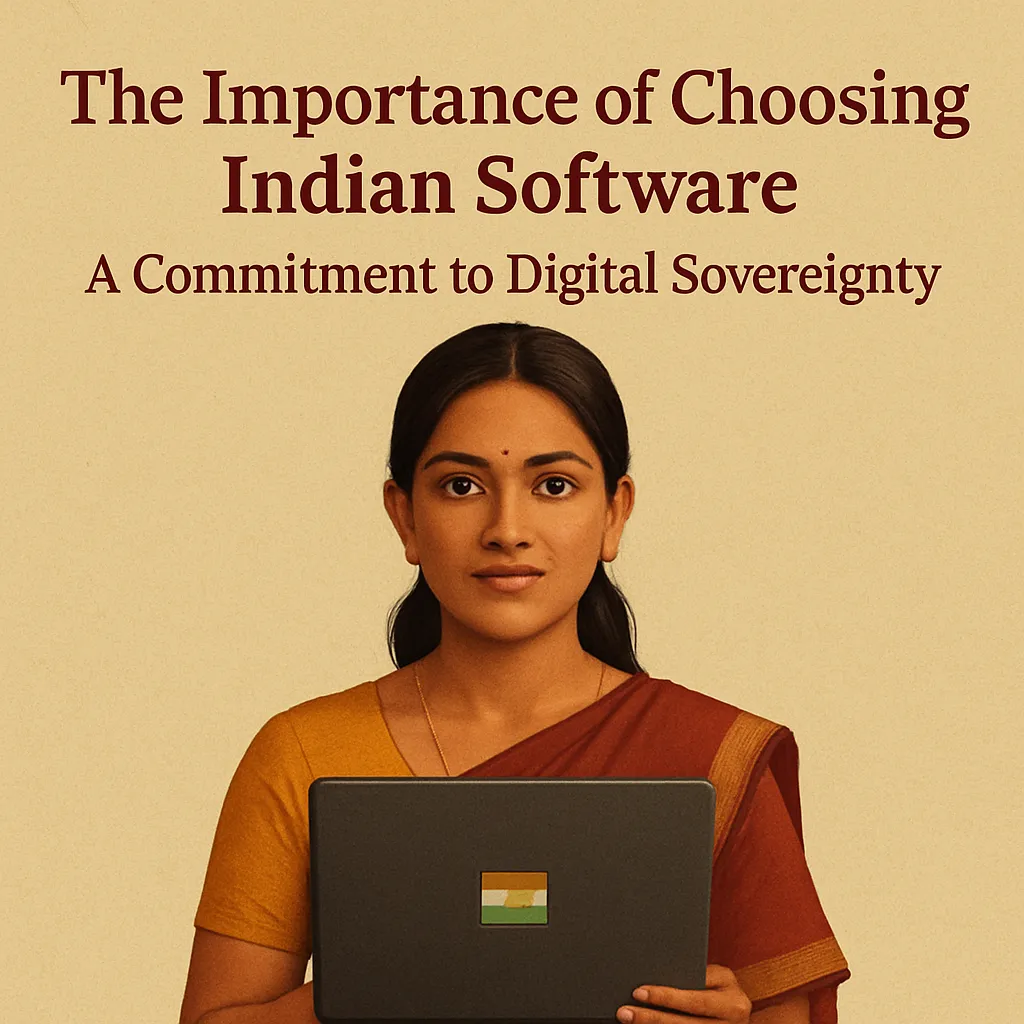
Two questions come up almost every time we discuss the case for choosing Indian software over international alternatives:
"Isn't every software solution ultimately linked to a foreign entity anyway?"
"Even with local hosting, how can we ensure true independence?"
These are fair, intelligent questions. They deserve honest, thoughtful answers - not patriotic slogans.
The reality is nuanced. Absolute independence from all foreign technology is neither achievable nor necessary. India participates in a global technology ecosystem, and much of the underlying infrastructure of the internet - from foundational protocols to open-source frameworks - is inherently international.
But here is what the question misses: there is a SIGNIFICANT DIFFERENCE between using a tool built by a foreign company and using a tool built by an Indian company. And that difference has profound implications for India's economy, its workforce, its data security, and ultimately its ability to chart its own digital future.
This blog unpacks that difference - clearly, practically, and without oversimplification.
The Question Deserves a Serious Answer
When someone asks "isn't every software linked to a foreign entity anyway?" - they are usually pointing to a real observation. Many Indian software companies use Amazon Web Services or Google Cloud as their infrastructure. Indian apps are often built using open-source frameworks originally developed in the United States. Indian developers use tools, libraries, and platforms created globally.
This is true. And it is not a problem.
The question of sovereignty in software is not about the origin of every component in your technology stack. It is about where value is created, where decisions are made, where profits flow, and where your data ultimately resides.
When you subscribe to Salesforce, a San Francisco company, the subscription revenue flows to California. The engineering decisions are made in California. The data processing agreements are governed by US law. The company's primary accountability is to its American shareholders and American regulators.
When you subscribe to Zoho CRM, a Chennai company, the subscription revenue flows to Tamil Nadu. The engineering decisions are made in Chennai and across India's technology hubs. The data processing is governed by Indian law. The company's primary accountability is to Indian regulations and Indian users.
Even if both products use some shared underlying internet infrastructure - the economic, legal, and sovereignty outcomes are fundamentally different.
Where the Real Money Goes
Cloud infrastructure - the servers that run software - represents a relatively small percentage of a technology company's total costs. The substantial expenditures in any software business are salaries, facilities, and go-to-market activities.
When you pay for Indian software, here is where your money actually goes:
Salaries go to Indian software engineers, Indian product managers, Indian designers, Indian data scientists, Indian support staff, and Indian sales professionals. These are well-paying, skill-building jobs in India's technology sector - jobs that create career paths, build institutional knowledge, and strengthen India's human capital.
Facilities fund Indian office spaces, Indian data centres, Indian server infrastructure, and Indian physical presence across the country. This investment flows directly into Indian real estate, Indian construction, Indian energy, and Indian logistics.
Research and Development funds Indian innovation - Indian teams working on Indian problems with Indian context. When Gnani.ai invests in voice AI for Indian languages, that R&D happens in India. When MapmyIndia invests in mapping India's roads and localities, that work happens on Indian soil by Indian teams.
Marketing and Sales funds Indian agencies, Indian media, Indian events, and Indian business development. Every rupee spent on promoting an Indian software product circulates within India's economy.
Taxes go to the Indian government - funding Indian public services, Indian infrastructure, Indian education, and Indian health systems.
When you choose a foreign software platform, the majority of this spending happens outside India. The jobs are foreign. The R&D is foreign. The taxes are foreign. The only India connection may be the servers in an Indian data centre region - and even those are owned and operated by a foreign company.
This is the significant difference. And it compounds over time.
Every Rupee Has a Multiplier Effect
Economists call it the multiplier effect - the idea that money spent in a local economy generates more than its face value in economic activity as it circulates through multiple transactions.
When an Indian business pays ₹10,000 per month for Indian software:
That ₹10,000 pays an Indian developer's salary - who spends it at an Indian restaurant, pays rent to an Indian landlord, buys from an Indian market, and saves with an Indian bank.
That ₹10,000 funds Indian R&D - which creates a better product, which attracts more Indian customers, which creates more Indian jobs.
That ₹10,000 generates Indian GST - which funds Indian roads, Indian schools, and Indian public services.
That ₹10,000 demonstrates to Indian and foreign investors that Indian software companies are commercially viable - which attracts more investment into India's technology ecosystem, which funds more Indian startups, which creates more Indian jobs and more Indian innovation.
When that same ₹10,000 goes to a foreign software company, most of this multiplier effect happens outside India. The jobs are created elsewhere. The taxes are paid elsewhere. The investment signal goes to foreign ecosystems.
The choice is not just about the product. It is about which economic ecosystem you are strengthening with every subscription payment you make.
Sovereignty Is Not Binary - It Is a Journey
This brings us to the second important reframing that answers the question "how can we ensure true independence?"
Sovereignty is not about achieving absolute independence. It never has been.
No country in the world operates in complete technological isolation - nor should India aspire to. India participates in global technology supply chains, benefits from international open-source contributions, and builds on decades of shared internet infrastructure. This is strength, not weakness.
What sovereignty means, practically, is direction of travel and degree of dependence.
Consider where India is today: most Indian enterprises run their critical operations on AWS or Azure. Most Indian professionals communicate through Gmail or Microsoft Outlook. Most Indian teams collaborate on Slack or Microsoft Teams. Most Indian customer data is managed in Salesforce or HubSpot. India's dependence on foreign digital infrastructure is currently very high - approaching 100% in many enterprise categories.
The goal is not to get to 0% foreign dependency. The goal is to move the needle meaningfully:
From 100% foreign → to 80% foreign / 20% Indian From 80% foreign → to 60% foreign / 40% Indian From 60% foreign → to 50% foreign / 50% Indian
Each step in this direction represents a meaningful improvement in India's digital sovereignty. Each step creates more Indian jobs. Each step funds more Indian R&D. Each step strengthens India's negotiating position in global technology markets. Each step builds the Indian technology ecosystem's capability to serve more needs.
This is not a revolution. It is a steady, pragmatic, cumulative shift - and every individual decision contributes to it.
The Investor Signal - Why Commercial Viability Matters
There is another dimension to this conversation that is rarely discussed but critically important: the signal that commercial success sends to investors.
India has produced extraordinary technology entrepreneurs and engineers. But for decades, the most ambitious Indian tech talent has built products for foreign markets - either by joining foreign companies or by building Indian startups specifically targeting Western customers, because that is where the commercial validation and venture investment has been strongest.
This creates a self-reinforcing cycle that works against India's domestic technology ecosystem. Indian software companies that primarily serve Indian customers are often undervalued by investors because India's enterprise market has historically been seen as price-sensitive and slow to adopt new software.
Every time an Indian enterprise chooses an Indian CRM over Salesforce, an Indian cloud over AWS, or an Indian HR platform over Workday - they are generating real revenue for Indian software companies and providing the commercial proof points that investors need to fund the next generation of Indian software startups.
Zoho's extraordinary global success is built on a foundation of Indian commercial credibility. Freshworks reached a billion-dollar valuation partly because Indian enterprises proved that Indian software companies could build products that serve real business needs. Razorpay's dominance in Indian payments demonstrates to the global investment community that Indian fintech companies can win at scale in their home market.
Each Indian business that subscribes to Indian software contributes to this investor signal - demonstrating that homegrown Indian startups are commercially viable, worthy of investment, and capable of building lasting enterprises.
Addressing the "Foreign Dependency" Concern Directly
Let us directly address the concern that even Indian software companies use foreign infrastructure, making true independence impossible.
This is accurate as a factual observation but misleading as a conclusion.
Yes, many Indian software companies currently use AWS, GCP, or Azure for some of their infrastructure. This is a pragmatic business reality - global cloud providers offer certain capabilities at competitive prices, and Indian software companies that are building and scaling make rational infrastructure choices.
But several important things are true simultaneously:
Indian software companies are increasingly migrating to Indian cloud infrastructure. E2E Cloud, Utho, Yotta, and other Indian cloud providers are growing rapidly, and Indian software companies are among their most significant customers.
The foreign infrastructure dependency of an Indian software company is fundamentally different from a foreign software company's relationship with India. The Indian company still employs Indian engineers, pays Indian taxes, makes decisions accountable to Indian regulations, and creates Indian economic value - regardless of which cloud provider hosts their servers.
And the trajectory matters. An Indian software ecosystem that generates strong commercial revenue will increasingly fund Indian cloud infrastructure, Indian hardware, and Indian foundational technology - reducing foreign infrastructure dependency over time. This journey begins with Indian businesses choosing Indian software.
A Pragmatic Strategy for Indian Businesses
Given all of the above, what does a pragmatic approach to Indian software adoption actually look like for an Indian business?
The answer is not a dramatic overnight switch that disrupts operations and creates risk. It is a deliberate, category-by-category evaluation that systematically favours Indian alternatives where they meet business requirements.
Start with new purchases
Whenever you are evaluating a new software category or renewing an existing subscription, include Indian alternatives in your evaluation. Give them a fair trial. You may find they meet your requirements better than you expected.
Prioritise categories where Indian alternatives are strongest
Payments, HR and payroll, email, CRM, and cloud hosting are categories where Indian alternatives are directly competitive with or superior to foreign options for Indian business needs. Start here.
Apply a deliberate tiebreaker
When an Indian alternative and a foreign alternative are roughly comparable on features and price, choose Indian. The marginal features difference is rarely worth the economic and sovereignty cost of choosing foreign.
Track your progress
Know what percentage of your software spend currently goes to Indian versus foreign platforms. Set a goal - move from 20% Indian to 40% Indian over the next two years, for example. This makes the shift concrete and measurable.
Share your experience
When Indian software works well for your business, tell other businesses. Write a review. Share on LinkedIn. The ecosystem grows through commercial success stories, and your experience is valuable to other Indian businesses considering the same switch.
Addressing the Hosting Question Directly
The second common question - "even with local hosting, how can we ensure true independence?" - deserves a direct answer.
Local hosting does not guarantee independence from foreign software vendors if the software itself is foreign-built and foreign-controlled. Running Salesforce on an Indian cloud provider's servers still means your CRM is controlled by Salesforce, governed by American law, and dependent on Salesforce's continued service provision.
True independence requires both Indian software and Indian infrastructure. When you use Zoho CRM hosted on E2E Cloud, you have both - an Indian software platform built by an Indian company, running on Indian infrastructure operated by an Indian company, with your data governed by Indian law.
This combination - Indian software on Indian infrastructure - is the foundation of genuine digital sovereignty for a business. It is achievable today, in most software categories, without compromising on quality or capability.
The combination also creates resilience. If geopolitical events cause a foreign software company to restrict service or change terms, a business running on Indian software is protected. If foreign government surveillance laws require a foreign cloud provider to hand over data, a business running on Indian infrastructure is protected. These are not hypothetical scenarios - they are real risks that Indian businesses face today by choosing foreign software and foreign infrastructure.
The Ecosystem Effect: Why Your Individual Choice Matters
One final point that is often underappreciated: your individual software choice, as a single business, has an impact that extends far beyond your own subscription payment.
Indian software markets are still relatively young and still growing. Many Indian software companies are at inflection points where additional commercial traction means the difference between becoming a sustainable, growing business and struggling to survive.
When you choose an Indian alternative, you are not just making a procurement decision. You are casting a vote for a particular future - a future where Indian software companies grow large enough to compete with foreign giants on all dimensions, where Indian technology talent builds world-class products for Indian and global markets, and where India's digital infrastructure is genuinely self-sufficient in the categories that matter most for national security and economic resilience.
That future is entirely achievable. India has the talent, the entrepreneurial energy, the market scale, and increasingly the technology products to make it real.
What it needs is Indian businesses that choose Indian.
Conclusion
The questions at the beginning of this article were fair ones. Yes, global technology is interconnected. No, choosing Indian software does not instantly create total independence.
But the difference between choosing Indian and choosing foreign is significant - in economic impact, in job creation, in R&D investment, in tax contribution, in ecosystem signal, and in the gradual, deliberate progress toward the digital sovereignty that India's scale and ambition deserve.
Sovereignty is not about achieving absolute independence. It is about a purposeful, progressive shift - from 100% foreign dependency to 80%, from 80% to 60%, from 60% to 50% and beyond. Each decision advances India toward that goal.
In an increasingly complex and geopolitically uncertain global landscape, fostering an Indian-first technology strategy is not just patriotic sentiment. It is pragmatic business strategy. It is sound national policy. And it is the right choice for every Indian business that wants to be part of building the digital India that the next generation deserves.
Start your shift today
Explore 200+ Indian software alternatives at indianalternatives.co.in